this post is a roller coaster, not in the way that people call wild posts “roller coasters,” but in the way that i knew something was up when i started reading the first paragraph, it was like the track slowly rising up, the wording just tipped me off, i knew there was going to be a serious drop that was going to give me whiplash, but when it arrived i still wasn’t ready for it
apparently the bbc is making a tv series based on the iliad and patroclus & achilles are played by black actors and omg why aren’t we talking about this????
I was at my cousin’s house for a family barbecue and she shushed us all bc her neighbor ‘The Captain’ was walking by with a dog, and he was just some skinny guy with a long ponytail and a captain’s hat walking an irish wolfhound so we all like ‘what’s the big deal’ but she told us to wait and then like ten minutes later he passed again on his way back to his house but he just…had a different dog. it was like a cocker spaniel. she said every day he leaves the house with the wolfhound and comes back with the tiny dog and she’s never seen them get returned either way. she can never find out where he walks to. shes been watching him for years. my family was freaking the fuck out one of my other cousins looked like he was about to have an aneurysm.
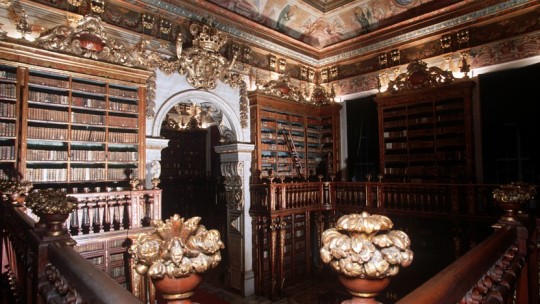
Today I learned that the university of Coimbra in Portugal has
a great 18th-century library, the Biblioteca Joanina, that maintains a colony of bats to effectively control the population of paper-eating insects called
papirófagos.
These bats are less than an inch long. They roost during the day behind the bookcases and come out at night. There doesn’t seem to be any English word for
papirófago, a cursory search turns up no details about what sort of insect they are, and ngl I am slightly concerned about them as a phenomenon. But I think my overarching point here is clear:
This library keeps tiny bats that look after the books.
For the first time, researchers have found evidence that underwater ecosystems have pollinators that perform the same task as bees on land.
Just like their terrestrial cousins, grasses under the sea shed pollen to sexually reproduce. Until now, biologists assumed the marine plants relied on water alone to spread their genes far and wide. But the discovery of pollen-carrying ‘bees of the sea’ has changed all of that.
Over several years from 2009 to 2012, researchers from the National Autonomous University of Mexico filmed the spring nocturnal wanderings of crustaceans among beds of turtle seagrass, Thalassia testudinum.
Looking through the videos, they spotted more invertebrates visiting male pollen-bearing flowers than those that lacked pollen – just like bees hovering around pollen-producing plants on land.
“We saw all of these animals coming in, and then we saw some of them carrying pollen,” lead researcher Brigitta van Tussenbroek told New Scientist.
The concept was so new, they invented a new term to describe it: zoobenthophilous pollination. Before that, researchers had never predicted that animals were involved in pollinating marine plants.





 Zoe's blog